Showing posts with label iron. Show all posts

Tuesday, 3 June 2014

The Many Uses of White Vinegar


Dri-Pak’s White Vinegar is one of the most versatile and economical products you can have on hand. Come and discover some key ways to put that bottle to good use!


There are different types of vinegar, but generally, White Vinegar is recommended for laundry and cleaning because it reduces the risk of staining fabrics and surfaces, plus it’s relatively cheap.


So how does it work?


This highly acidic liquid is a smart way to clean without relying on harsh chemicals. To see this in action, pour alkaline Bicarbonate of Soda down the plughole, followed by White Vinegar. The fizzing action is a result of the two substances reacting with one another. (By the way, this is a great way to clear plugholes!)


When it comes to cleaning clothes, White Vinegar is great for tackling deodorant-stained shirts. While deodorant stains can be difficult to remove, acidic products like White Vinegar and Citric Acid can dissolve the aluminium salts in the stain. More laundry and cleaning tips.


Regularly spray the underarm areas with White Vinegar before washing as normal. This will help to prevent staining.


In addition, spraying White vinegar onto deodorant-stained shirts before the wash can ease the discoloration - it’s also great for tackling mustard, tomato sauce, or ketchup stains.


White Vinegar works magic on upholstery too. If your child has an ‘accident’ on a mattress, clean it with a solution of White Vinegar and water. Afterwards, pour some baking soda onto the mattress, and brush or vacuum the residue once it’s dry.


Adding a cupful of White Vinegar to the rinse cycle of your washing machine can freshen up bright colours and give you cleaner laundry. Acetic acid won’t harm fabrics, but it helps dissolves the soap residue that can dull dark clothing. It also acts as a fabric softener, a static reducer and a mildew-inhibitor. More information on white vinegar for laundry use.


To help remove mineral deposits and prevent corrosion on your steam iron, give it an occasional cleaning by filling the reservoir with undiluted White Vinegar. Place the iron in an upright position, switch on the steam setting, and let the White Vinegar steam through it for 5-10 minutes. Then refill the chamber with clean water and repeat. Finally, give the water chamber a good rinsing with cold, clean water.


White Vinegar can clean and deodorise, just about everything. From keeping your laundry fresh and clean, to preventing deodorant stains, there’s not much that it can’t do. As an alternative to expensive and harsh cleaning chemicals, White vinegar is something you can feel good about keeping in your cupboards, it’s just a great, green buy!


Thursday, 12 April 2012

Win the War against Limescale!


There’s nothing like putting your feet up at the end of a long day with a lovely cup of… limescale?!

If you live in a hard water area you’ll know what a pain limescale can be. Not only does it ruin your tea, it leaves water marks everywhere, stops your shampoo from lathering properly, reduces the efficiency of appliances and can even contribute to them breaking down.

Luckily we’re here to arm you with clever tips and tricks to defeat that gunk!

Know your enemy


Here comes the science bit, concentrate!

Limescale is essentially alkaline mineral - calcium bicarbonate - suspended in water. It’s actually very good for us to drink this water because of the rich minerals in it, but it can play havoc with appliances that heat water like your washing machine, kettle, dishwasher, iron etc.

A lovely lump of limescale!

This is because the minerals are attracted to heating elements. When the soluble calcium bicarbonate minerals are heated they become calcium carbonate – a poorly soluble substance that therefore ‘sticks’ to the element. As more and more limescale builds up on the heating element, it requires more and more energy to heat the water and may eventually lead to the appliance breaking down.

So now you know what it is, how can you stop it ruining your stuff?


Prevention is better than cure


Water softeners use sodium to replace the calcium in the water - the same principle applies when we advise using Soda Crystals in each wash. Soda Crystals are also known as sodium carbonate, and work to soften the water in your washing machine, making laundry detergents work better and preventing limescale from sticking to heating elements. Soda Crystals also help to remove stains on clothing, as well as detergent build up in the machine. Use between 25g-50g in each wash and you will also find that you don’t need to use as much detergent too – pretty cool huh!

Different areas of the country have harder water and so require the full 50g, whereas areas with softer water won’t necessarily need as much. This map highlights the areas of hard water in England and Wales.


Fight fire with fire!


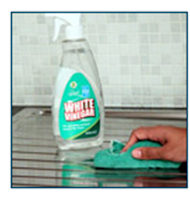
Because limescale is alkaline, acidic cleaners like White Vinegar and Citric Acid work best at removing it. Below are a few methods for removing limescale from surfaces and appliances.

Dishwashers
Draining Boards
Coffee Machines

Kettles

Shower Screens
Irons

So don't let limescale ruin your next cuppa - fight it head on with your army of traditional and natural products!

Bookmark and Share

Thursday, 16 February 2012

Cut out the hassle when it comes to ironing!


If you find your iron sometimes leaves marks on your freshly washed clothes you’ll know what a pain it can be! The marks are most likely mineral deposits and limescale being left in the reservoir of the iron. 

If limescale is a particular issue in your area then you’ll no doubt have encountered problems it can cause in other appliances around the home! There’s nothing worse than having to put your clean clothes back into the washing machine, but how do you clean the inside of an iron?

Simple White Vinegar is the best way to clean the inside of the appliance - it’s also a natural product as well an economical one! 

To clean your iron, empty the reservoir from old water as best you can and fill the reservoir a third full with White Vinegar. Switch the iron onto the steam setting and iron an old cloth until all the white vinegar has been used. Switch off the iron and leave to cool. Repeat the process with clean water to flush out any remaining vinegar in the reservoir. Make sure you empty the reservoir of water every time you finish with the iron to reduce future deposits forming inside the appliance. 


Bookmark and Share

Monday, 15 November 2010

Cut out the hassle when it comes to ironing!


If you find your iron sometimes leaves marks on your freshly washed clothes you’ll know what a pain it can be! The marks are most likely mineral deposits and limescale being left in the reservoir of the iron. If limescale is a particular issue in your area then you’ll no doubt have encountered problems it can cause in other appliances around the home! There’s nothing worse than having to put your clean clothes back into the washing machine, but how do you clean the inside of an iron?!

White Vinegar is the best way to clean the inside of the appliance - it’s also a natural product as well an economical one! To clean your iron, empty the reservoir from old water as best you can and fill the reservoir a third full with White Vinegar. Switch the iron onto the steam setting and iron an old cloth until all the white vinegar has been used. Switch off the iron and leave to cool. Repeat the process with clean water to flush out any remaining vinegar in the reservoir. Make sure you empty the reservoir of water every time you finish with the iron to reduce future deposits forming inside the appliance.